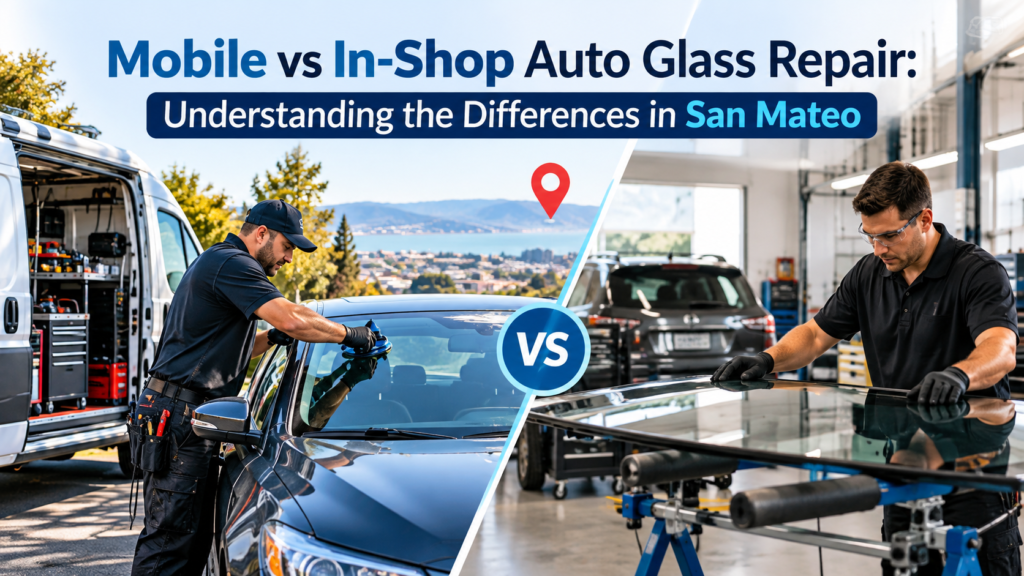
Auto glass work can happen in two very different settings. In one, a technician arrives where the vehicle is parked, whether that is a driveway, an office lot, or a curbside space, and does the job there. In the other, the vehicle goes into a dedicated service bay with controlled conditions and fixed equipment. Both approaches are widely used, and both produce sound results when the circumstances suit them. The interesting question is not which one is better in general, but which conditions favor each.
That question has more to it than convenience. A windshield bond depends on chemistry, temperature, and cleanliness. Many modern vehicles also carry cameras and sensors behind the glass that must be realigned after the windshield is changed. This guide walks through how Mobile vs In Shop Auto Glass Repair Sanmateo differ in environment, equipment, curing, calibration, and practical logistics, with attention to the conditions that drivers in San Mateo and the surrounding Peninsula commonly face.
What the Two Settings Mean
Mobile auto glass service means the work is performed at the vehicle’s location, using a van or truck stocked with tools, glass, adhesives, and supplies. The technician brings the shop to the car. In-shop service means the vehicle is driven or towed to a facility, where the work is done indoors with access to fixed equipment.
The type of work matters. Chip and small crack repair involves injecting resin into the damaged area and curing it with ultraviolet light, which is a short and portable process. Full windshield or door glass replacement involves removing the old glass, preparing the frame, applying adhesive, and setting the new glass, which is more sensitive to environment. The comparison below applies differently to each.
Environmental Control: The Biggest Practical Difference
Auto glass adhesive is sensitive. The urethane that bonds a windshield to the vehicle is applied as a thick bead, and the surfaces it touches must be clean, dry, and properly primed. Dust, moisture, and oils can interfere with adhesion.
In a shop, those variables are easier to control. The floor is flat, the air is sheltered from wind and rain, and the temperature can be kept within a narrow range. Dust is limited, and the vehicle can sit undisturbed while the adhesive cures.
Outdoors, the technician works around the weather. Wind can carry dust and pollen onto the bonding surface. Rain or heavy fog can leave moisture where it should not be. Direct sun can heat the glass and the frame unevenly, and cold air can slow the chemical reaction. Experienced mobile technicians manage these factors with portable canopies, careful timing, and judgment about when conditions are unsuitable, and they will reschedule rather than proceed in poor weather.
San Mateo’s climate helps in this regard. The Peninsula has mild temperatures most of the year, with limited extreme heat or cold. The main outdoor challenges are damp mornings from the marine layer, winter rain, and occasional strong wind. Those conditions are manageable but worth planning around.
How Adhesive Curing Works and Why It Matters
Most auto glass urethane is moisture-curing. It reacts with humidity in the air to harden, and the speed of that reaction depends on temperature, humidity, and the specific product. The key concept is safe drive-away time, which is the minimum interval after installation before the vehicle can be driven safely, since the bond must be strong enough to hold the glass in a collision and to let the airbag deploy correctly.
Safe drive-away times vary by adhesive and conditions, and they can range from under an hour for fast-curing products to several hours for others. Colder and drier conditions lengthen the time, and warmer, more humid conditions shorten it. The technician selects an adhesive suited to the temperature and vehicle, and follows the manufacturer’s instructions.
This curing step is one place where the two settings differ. In a shop, the vehicle can stay indoors during the early cure in a stable environment. In a mobile setting, the vehicle is left outside, though the same adhesive and the same safe drive-away guidance apply. Most mobile services are built around that reality, using fast-curing adhesive where appropriate and explaining the waiting time to the vehicle owner.
Driver Assistance Calibration
This is increasingly the most significant factor. Many vehicles now have advanced driver assistance systems, often called ADAS, with forward-facing cameras mounted behind the windshield near the rearview mirror. These cameras support features like lane departure warning, automatic emergency braking, adaptive cruise control, and traffic sign recognition. When the windshield is replaced, the camera is removed or disturbed, and its aim must be verified and often recalibrated.
Calibration comes in two main forms.
Static calibration takes place with the vehicle stationary. Targets or patterns are placed at precise distances in front of the car, and a scan tool tells the camera to adjust itself based on what it sees. This requires a level floor, controlled lighting, adequate space, and accurate measurements. It is most commonly done in a shop with dedicated equipment.
Dynamic calibration takes place while driving. The vehicle is driven on well-marked roads at specified speeds, and the system learns its alignment from lane markings and surroundings. It requires clear road conditions, visible markings, and the right weather.
Some vehicles require static, some dynamic, and some both. The vehicle manufacturer specifies which. The in-shop environment is generally better suited to static calibration, while some mobile operations carry portable target systems and can handle certain calibrations on site, provided there is enough level space and good lighting. Not every parking lot meets the requirement.
Because calibration affects safety systems, it is a practical consideration when thinking about where the work is done. It is also worth noting that even a perfectly installed windshield can leave a camera misaligned by a small fraction of a degree, which at highway distances translates into noticeable error.
Equipment and Tools
A shop has a fixed advantage in equipment. Lifts, glass racks, stationary heaters, calibration targets, and larger inventories of parts are all easier to maintain in a building. A shop can also stock a wider range of glass types, trims, and accessories.
A mobile unit carries a compact set of tools, including suction cups for handling glass, cutting tools, primers, adhesive, and a selection of the most common windshields. For routine jobs, this is typically enough. For unusual vehicles, specialty glass, or rare trim parts, the technician may need to order the part in advance and return, or the job may be moved to a shop.
Types of Jobs and Which Setting Fits
Different work has different needs.
| Type of work | Mobile | In-shop |
|---|---|---|
| Chip repair | Well suited, since resin and UV light are portable | Equally suited |
| Short crack repair | Well suited when the crack is clean and dry | Equally suited |
| Side or rear window replacement | Often practical | Practical |
| Windshield replacement, no ADAS | Commonly done on site in good conditions | Commonly done indoors |
| Windshield replacement with ADAS | Possible with portable calibration and enough space | Often preferred for static calibration |
| Heavily rusted frame or complex repairs | Limited by tools and space | Better suited |
| Rare or specialty glass | Depends on parts availability | Often better equipped |
The table reflects tendencies, not rules. A well-equipped mobile operation and a modest shop can overlap significantly.
Weather and Timing in San Mateo
The Peninsula’s climate affects the mobile option more directly. Winter rain can postpone outdoor work, because water on the glass or frame interferes with adhesion. Fog often burns off by late morning, so morning appointments may be affected by dampness while afternoon appointments are drier. Wind, especially afternoon gusts, can raise dust.
Summer is generally ideal for outdoor work, with warm, dry conditions that help the adhesive cure. The caution is direct sun on a hot day. A windshield that has been baking in the sun can be too hot to handle, and the adhesive cures faster than expected, so technicians often work in shade when possible.
A shop sidesteps most of this. Rain, wind, and sun are irrelevant indoors, and the schedule is more predictable.
Location, Space, and Logistics
Practical access is a major reason people choose one setting over the other. San Mateo has a mix of single-family homes with driveways, apartment complexes with shared lots, downtown parking, and office campuses. A mobile technician needs a spot with enough room to open doors, move glass, and work safely. A tight garage or a crowded street may be difficult.
In-shop service requires getting the vehicle to the facility. This is simple for a drivable vehicle with minor damage, but it may be more complicated if the windshield is badly cracked, visibility is impaired, or the vehicle is not safe to drive.
Another consideration is time. Mobile service removes travel and waiting, which matters to people with tight schedules, while in-shop work involves transport but offers a single place where the work, calibration, and inspection can be completed together.
Quality and Safety Are Not Tied to Location
It is easy to assume one setting is inherently safer. In practice, quality depends on the process. A properly done installation follows the same steps in either place: protecting the vehicle, removing the old glass, cleaning and priming the surfaces, applying adhesive to the specifications, setting the glass accurately, and allowing the correct cure time. Technician training and adherence to adhesive manufacturers’ guidelines matter more than the building around the vehicle.
Industry standards in the United States, such as those developed through the Auto Glass Safety Council and the Auto Glass Replacement Safety Standards, outline recommended procedures. These emphasize correct adhesive handling, proper cure times, and inspection. They apply to both mobile and shop work.
After the Work: Aftercare Is the Same Either Way
Regardless of where the glass is installed, the first days afterward are important. Common aftercare guidance includes:
- Leave retention tape in place for the period recommended by the installer, usually around a day.
- Avoid slamming doors for the first day or two, since the pressure change can disturb a fresh bond.
- Keep the vehicle out of automatic car washes, especially those with high-pressure jets, for the period specified.
- Do not remove or scrape stickers and trim immediately.
- Leave a window cracked slightly if instructed, to relieve cabin pressure.
- Watch for any water leaks, wind noise, or loose trim, and mention them promptly.
These steps support the adhesive during its cure and are equally relevant after a mobile or shop installation.
Common Misunderstandings
“Mobile glass work is lower quality.” The process is the same, and quality depends on training, adhesives, and conditions. A well-run mobile service follows the same standards as a shop.
“A shop is always required for ADAS.” Some calibrations can be done on site with portable equipment, though space and lighting must be suitable. Some require a shop.
“The glass is ready as soon as it is installed.” The adhesive needs time to reach safe strength. The safe drive-away time is a real safety threshold.
“Any weather works.” Heavy rain, strong wind, and extreme temperatures affect the process and may call for rescheduling.
“Chip repair requires a shop.” Chip repair is brief and portable, which makes it well suited to mobile service.
Frequently Asked Questions
Is mobile auto glass repair as reliable as in-shop repair?
The reliability depends on the process rather than the location. With trained technicians, quality adhesive, and suitable conditions, both approaches can produce a strong, safe result. Poor weather or limited space can make an outdoor job more difficult.
Can a windshield be replaced in the rain?
It is generally avoided, because moisture interferes with adhesive bonding. Technicians may use a canopy or reschedule, and an indoor facility is not affected by rain.
What is safe drive-away time?
It is the minimum waiting period after installation before the vehicle can be driven. It ensures the adhesive has cured enough to hold the glass securely in a collision and to support the airbag. It varies by adhesive, temperature, and humidity.
Does every windshield replacement need ADAS calibration?
Not every vehicle has driver assistance cameras, but many modern ones do. If the vehicle has a camera behind the windshield, calibration is typically required by the manufacturer after replacement.
What is the difference between static and dynamic calibration?
Static calibration is done with the vehicle stationary using targets and a scan tool. Dynamic calibration is done by driving the vehicle on suitable roads so the system learns its alignment. Some vehicles require one, some the other, and some both.
Can chip repair be done in a driveway?
Yes. Chip repair uses resin and a UV light and can be done almost anywhere with reasonable light and dry conditions. Rain or direct moisture on the chip can complicate it.
How long does the work take?
Chip repair is typically completed in a short visit. Windshield replacement takes longer, and the safe drive-away period adds waiting time afterward. Calibration, if needed, can add further time.
Does the weather in San Mateo affect auto glass work?
Somewhat. Damp mornings, winter rain, and wind can all interfere with outdoor installation, while mild, dry conditions are ideal. Indoor work is not affected.
Final Thoughts
Mobile and in-shop auto glass repair share the same materials, methods, and goals. They differ in environment, equipment, and logistics. A controlled indoor space offers stable conditions and room for calibration equipment, while on-site service offers convenience and works especially well for chip repair and straightforward replacements in suitable weather.
For anyone reading about mobile vs in-shop auto glass repair in San Mateo, the most useful lens is the conditions of the job: the type of damage, the vehicle’s technology, the weather, and the available space. Understanding how adhesive cures, why calibration matters, and how the environment affects both makes it much easier to see where each approach fits.